Two custom leather keychains can look identical in a product photo and age completely differently in a pocket. One develops a rich patina and keeps its logo crisp for years; the other cracks at the fold and the mark rubs away by the second season. The difference is almost always in two decisions made before anything is printed: the leather itself, and the method used to put your mark on it. Understanding both is what separates a keychain that feels like a giveaway from one that feels like a gift.
The Leather Grade Sets the Ceiling
Leather is graded by which layer of the hide it comes from, and the label on the product can be misleading. Full-grain is the top layer with the grain surface intact, including the natural marks; it is the strongest, ages the best, and is what you want for a keychain that gets handled constantly. Top-grain has that surface sanded and refinished, which makes it more uniform and slightly thinner but sacrifices some strength and the ability to patina. Genuine leather sounds premium but usually refers to lower splits of the hide finished to look better than they perform. Bonded leather is leather scrap ground up and glued to a backing, and it has no place in a product meant to survive a keyring; it delaminates and cracks. For a keychain, full-grain or a good top-grain is the honest starting point, and it is worth asking a supplier to name the grade specifically rather than accepting the vague catch-all term on a spec sheet.
Tannage Decides How It Takes a Mark
How the hide is tanned matters as much as its grade when you plan to customize it. Vegetable-tanned leather is firm, dense, and reacts beautifully to heat and pressure; it tools and burnishes well and darkens over time, which is why a pressed logo on veg-tan actually deepens and improves with age. Chrome-tanned leather is softer, more flexible, available in a wide range of fast colors, and more water-resistant, but it does not hold a deep impression the way veg-tan does. As a rule of thumb, if your design depends on a crisp pressed logo, lean toward vegetable-tanned; if it depends on color and a specific finish, chrome-tanned gives you more range and pairs better with laser work.
Match the Personalization Method to the Leather
There are two dominant ways to mark a leather keychain, and they suit different leathers, volumes, and looks. Debossing presses a heated metal die into the surface, typically at around 120 to 180 degrees Celsius under several tons of pressure, leaving a clean sunken impression without removing any material. It excels on vegetable-tanned, full-grain hides, where the impression darkens and wears well because nothing has been cut away. Add metallic foil to that same heated-die process and you have foil stamping, which lays a crisp gold or silver logo into the impression. Laser engraving takes the opposite approach, using a focused beam to ablate the surface fibers with no physical die at all. It shines on chrome-tanned and pigmented leathers, where burning through the topcoat reveals a sharp contrast, and it handles fine detail and one-off personalization that a die cannot.
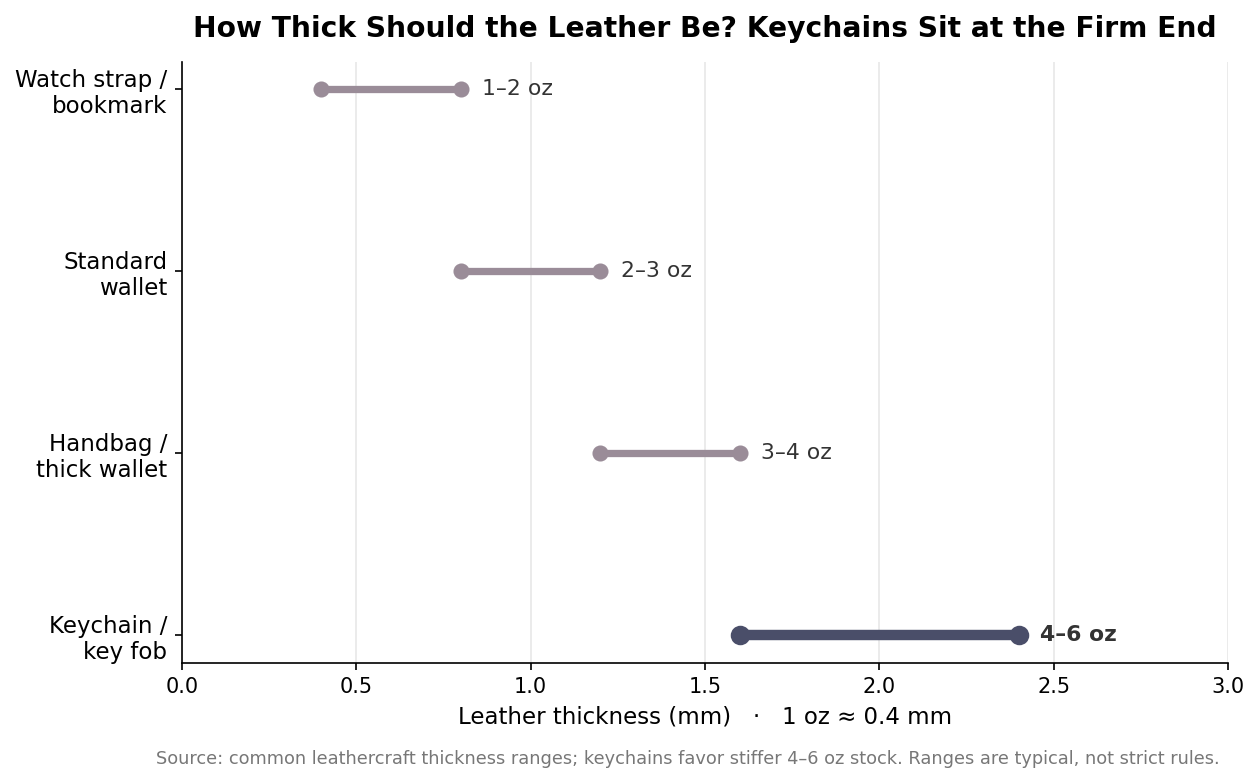
Two cautions are worth building into the spec. Debossing flattens the nap on suede and nubuck, so those materials are a poor match for a pressed logo. And laser-engraved edges on very soft or heavily finished leather can show wear or slight fraying after heavy cycling, so on a keychain that will ride in a pocket all day, a slightly firmer stock holds detail longer. The thickness question connects here too: keychains generally want stiffer leather than wallets, commonly in the four to six ounce range, which translates to roughly 1.6 to 2.4 millimeters, since one ounce of leather weight equals about 0.4 millimeters of thickness.
Let Order Volume Pick the Process
Cost structure, not just looks, should steer the method for larger orders. Debossing and foil stamping carry a real tooling cost because a custom die has to be made, often somewhere in the range of one hundred fifty to five hundred dollars, after which the per-unit cost is low. Laser engraving has no tooling cost but a higher per-piece charge, which makes it the economical choice for small and highly varied runs. Those two cost curves cross, and knowing roughly where tells you which process to quote.
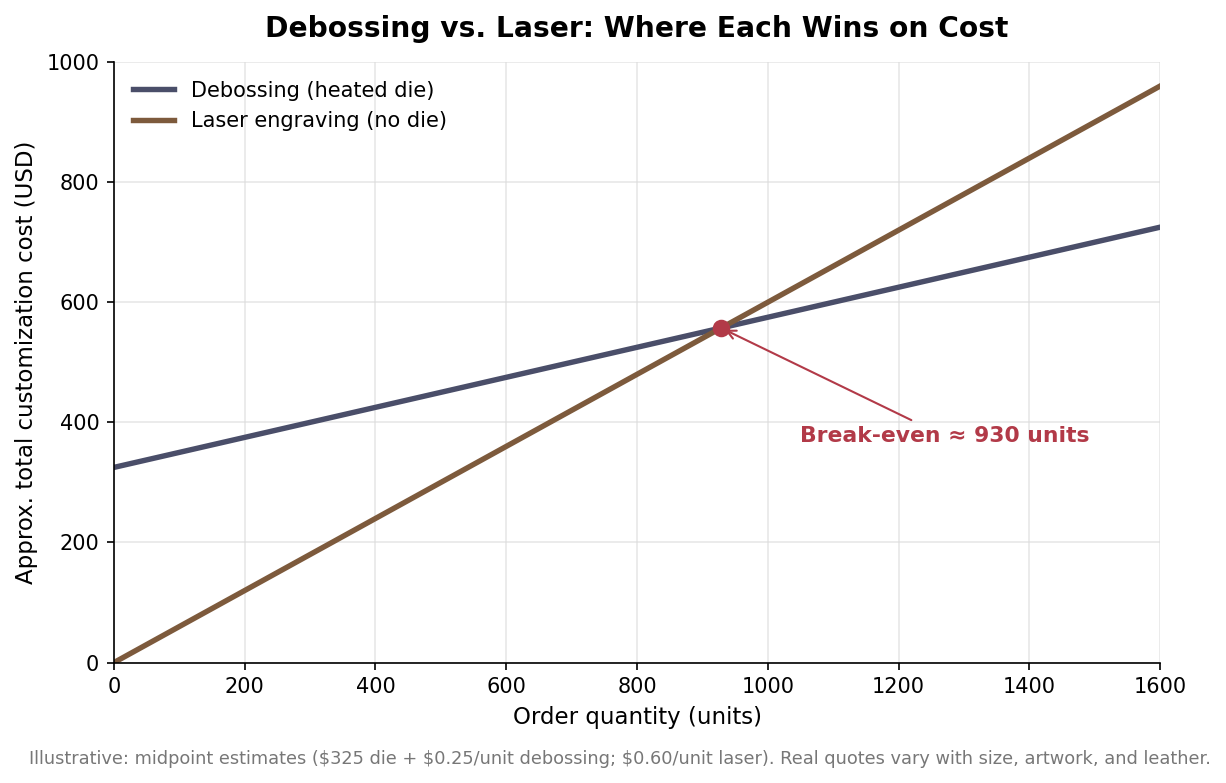
Using midpoint figures, a die-based process tends to pull ahead once an order climbs past roughly nine hundred to a thousand identical pieces, while below a few hundred units laser is usually cheaper and far more flexible. If every keychain needs a different name or number, laser wins regardless of volume because a die can only carry one fixed design. Treat those numbers as planning estimates rather than quotes, since real pricing shifts with size, artwork complexity, and the leather you choose.
Specify It So the Sample Matches the Order
Pull the decisions into a short spec and the sampling process gets much more predictable. Name the grade and tannage, for example full-grain vegetable-tanned; set the thickness in ounces or millimeters; choose the method and, for debossing or foil, approve a die proof of the logo at its real size; and confirm the hardware, since a solid split ring, a screw-in stud, or a swivel clasp each changes how the finished piece feels. As an indicative planning figure, custom leather keychains commonly run somewhere from a couple of dollars to well over ten dollars per piece depending on leather, method, and quantity, with minimums often starting in the low hundreds; confirm those against a real quote. Approve a physical sample on the exact leather before the full run, because leather is a natural material and the same design reads differently on a firm veg-tan tab than it does on a supple chrome-tanned one.